
Translating Complexity into Strategic Action
The Commission has proposed around €175 billion for the 2028–2034 Framework Programme, almost twice the current one. That figure will dominate the negotiations. What happens after the money arrives gets far less attention.
The Commission has proposed around €175 billion for the 2028–2034 Framework Programme, almost twice the current one. That figure will dominate the negotiations. What happens after the money arrives gets far less attention.
Last weekend, cost-of-living protests filled streets from Paris to Milan, Brussels and Lisbon. Students in France and Belgium have spent weeks protesting university fees. Germany is arguing over pensions, and Spain goes to the polls on 29 November. Meanwhile, Italy and Spain have agreed to end the temporary air and sea border checks they introduced in August, following talks between their interior ministers. That is how Europe usually moves forward: slowly, and far from the headlines.
Slow is not the same as stuck. A recent conversation with colleagues in academia reminded me where much of the forward movement comes from. Universities are where Europe’s knowledge is generated, from basic science to the evidence behind its laws. They offer what a divided moment lacks: findings that outlast an election cycle, researchers trained to work across borders, and networks that keep running when governments change.
AI governance shows how this works. Europe has its AI law. Making it work takes research on how people actually use AI systems, projects that build safeguards in from the design stage, and teams that carry that knowledge from one grant to the next. Behind every funded project there is also a research management team turning ideas into consortia, budgets and results, work that few people outside a university ever see.
Having worked both inside international organisations and alongside them, I find this the most compelling part: helping knowledge become lasting capacity inside an institution.
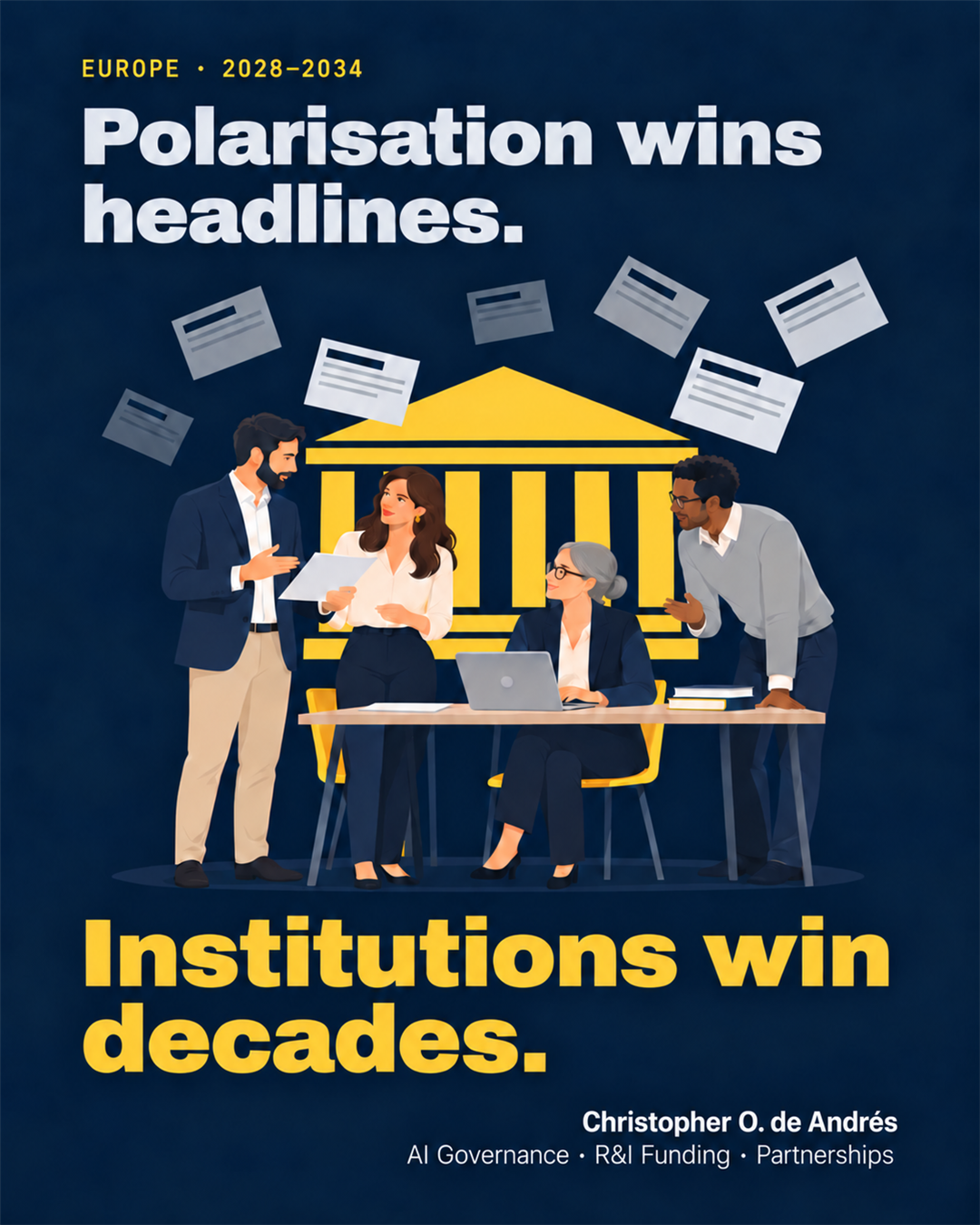
Polarisation wins headlines. Institutions win decades.
What would need to change for each research grant to leave the institution behind it stronger, not just fund the next project?
Last weekend, cost-of-living protests filled streets from Paris to Milan, Brussels and Lisbon. Students in France and Belgium have spent weeks protesting university fees. Germany is arguing over pensions, and Spain goes to the polls on 29 November. Meanwhile, Italy and Spain have agreed to end the temporary air and sea border checks they introduced in August, following talks between their interior ministers. That is how Europe usually moves forward: slowly, and far from the headlines.
Slow is not the same as stuck. A recent conversation with colleagues in academia reminded me where much of the forward movement comes from. Universities are where Europe’s knowledge is generated, from basic science to the evidence behind its laws. They offer what a divided moment lacks: findings that outlast an election cycle, researchers trained to work across borders, and networks that keep running when governments change.
AI governance shows how this works. Europe has its AI law. Making it work takes research on how people actually use AI systems, projects that build safeguards in from the design stage, and teams that carry that knowledge from one grant to the next. Behind every funded project there is also a research management team turning ideas into consortia, budgets and results, work that few people outside a university ever see.
Having worked both inside international organisations and alongside them, I find this the most compelling part: helping knowledge become lasting capacity inside an institution.
Polarisation wins headlines. Institutions win decades.
What would need to change for each research grant to leave the institution behind it stronger, not just fund the next project?
Mine: keeping the people who know how to run a project from one grant to the next. Too often, that knowledge leaves when the contract ends.
Posted by Christopher Óscar de Andrés, on Friday, October 23rd 2026 at 08:00
|
Comments (0)
Nine partners. Six countries. One deadline. AI helps polish their contributions. The proposal reads as one voice. But has the consortium agreed on one promise? The European Commission allows AI-assisted drafting, while requiring transparency, validation and applicant responsibility. The model can help write the commitment. It cannot make it on a partner’s behalf.

One impact claim, three readings. Agreeing on what a target measures is a consortium decision, not a drafting task.
Take one illustrative line from an impact section: ‘We will reach 40,000 users.’
→ The university means people reached through communication.
→ The SME means potential customers.
→ The public authority means citizens expected to benefit from a service.
One number. Three different commitments. The wording looks consistent. The expectations are not. AI did not create the gap. It made it look finished. Before anyone validates the figure, someone has to get the partners to agree on what it measures.
Communication, dissemination and exploitation make that distinction essential: building awareness, sharing research results and putting them to use require different measures of success. An audience reached is not proof of adoption. A credible proposal explains who is expected to use the results, what would enable that use and which partner takes responsibility for the next step.
Resolving this takes negotiation from the start. Universities, companies and public bodies bring different missions, data policies and definitions of success. Alongside budgets and work packages, partners need to agree what information may enter AI tools, who validates claims against sources and assumptions, and who approves the commitments made in their name. Only then does the writing team know what it is writing.
Getting institutions to agree on what they promise, how they will demonstrate delivery and who takes responsibility has been central to my work. That agreement gives a proposal its credibility long before submission. Building it is what I want to bring to a research office or an institution with European partnerships at its core. For coordinators and research offices: who checks that a shared target means the same thing to every partner?
→ The university means people reached through communication.
→ The SME means potential customers.
→ The public authority means citizens expected to benefit from a service.
One number. Three different commitments. The wording looks consistent. The expectations are not. AI did not create the gap. It made it look finished. Before anyone validates the figure, someone has to get the partners to agree on what it measures.
Communication, dissemination and exploitation make that distinction essential: building awareness, sharing research results and putting them to use require different measures of success. An audience reached is not proof of adoption. A credible proposal explains who is expected to use the results, what would enable that use and which partner takes responsibility for the next step.
Resolving this takes negotiation from the start. Universities, companies and public bodies bring different missions, data policies and definitions of success. Alongside budgets and work packages, partners need to agree what information may enter AI tools, who validates claims against sources and assumptions, and who approves the commitments made in their name. Only then does the writing team know what it is writing.
Getting institutions to agree on what they promise, how they will demonstrate delivery and who takes responsibility has been central to my work. That agreement gives a proposal its credibility long before submission. Building it is what I want to bring to a research office or an institution with European partnerships at its core. For coordinators and research offices: who checks that a shared target means the same thing to every partner?
Category


Recent posts

Archives
#AIAct
#AIGovernance
#AITransparency
#ArtificialIntelligence
#EUFunding
#EuropeanUnion
#FinanciaciónDeLaInvestigación
#GestiónDeLaInvestigación
#HorizonEurope
#HorizonEurope #AIGovernance #ResearchManagement
#JustificaciónEconómica
#ResearchManagement
#ScienceCommunication
#StrategicCommunication
#Transferencia
EU projects
Financiación de la investigación
Gestión de la investigación
Grant management
Horizon Europe
Justificación económica
Proyectos europeos
Research management